“Unless You Become as Little Children…”
The Snow Queen“Unless You Become as Little Children…” is the biblical saying that gives the ending of the story its meaning. Read by Grandmother as Kay and Gerda return home, it links their survival and reunion to a quality the narrative calls purity and innocence of heart: they are grown, but still children at heart.
The Saying and Its Context
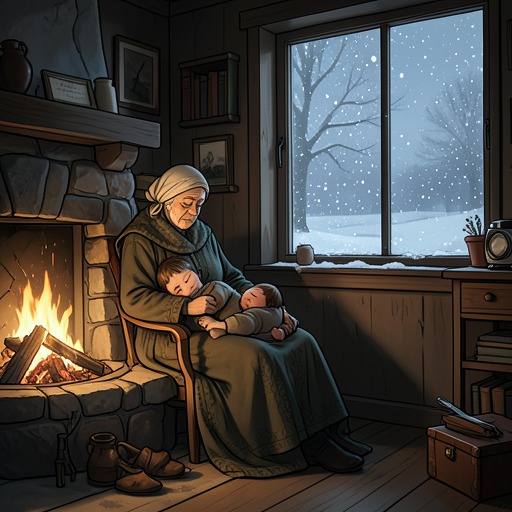
The saying appears in the final scene, not as an instruction issued at the start of the children’s adventures but as a frame through which their return can be understood. After the Snow Queen’s palace and the journey back, Kay and Gerda reach Grandmother’s door and enter the familiar little room. Grandmother sits in God’s bright sunshine reading from the Bible: “Except ye become as little children, ye shall in no wise enter into the kingdom of God.” The words place their reunion within a Christian understanding of childhood, innocence, and spiritual belonging.
The story’s opening makes the contrast with childhood especially sharp. The Demon’s looking-glass enlarges what is bad and diminishes what is good; its fragments distort perception and can make the heart cold. Against that world of distortion, the saying at the close offers a different measure of sight and worth. The ending does not claim that the children have avoided suffering or remained untouched by it. Instead, it presents their return and recognition of the old song as compatible with a childlike inwardness.
Childhood Before the Separation
Kay and Gerda’s childhood is first established through ordinary closeness and shared play. Though they are not brother and sister, they love one another almost as if they were. Their families live opposite each other in garrets, and wooden boxes of herbs and rose-bushes bridge the space between their windows. In summer, the children sit beneath the flowers; in winter, warmed pennies held to the frozen panes make small holes through which they can see one another. Their childhood is thus associated with affection, resourcefulness, and a small shared world made from the space between two homes.
The roses also connect childhood to the story’s religious language. Gerda learns a hymn about roses and sings it with Kay among the blossoming flowers. Its promise that they will see the Christ-child becomes a recurring expression of hope. At the end, when they sit together again, the familiar words return to their understanding. The saying from the Bible and the song do different work in the final scene: Grandmother reads the former, while Kay and Gerda recognize the latter, joining adult instruction to a memory formed in childhood.
Innocence Tested Through Action
The story tests the value associated with childhood through danger rather than protecting it inside the garden. When Gerda runs out into the world, she discovers that the garden’s perpetual summer has concealed the passing seasons; autumn has advanced, and her feet are sore. Her journey is not a retreat into safety. It repeatedly asks whether care and loyalty can persist amid hardship, and whether Gerda can act without the power or protection that adults and magical helpers might provide.
The Snow Queen’s guards make that question concrete. Gerda reaches the cold, ice-bound country without shoes or gloves, and living snowflakes close around her. She repeats the Lord’s Prayer; the steam of her breath takes the shape of little Angels, whose spears break the snowflakes apart and open a safe way forward. Earlier, the Finland woman has explained that she can give Gerda no greater power than the strength she already possesses, which consists in purity and innocence of heart. The rescue scene dramatizes that claim: Gerda’s prayer and persistence carry her through a danger that cannot be overcome by simply making her stronger through someone else’s gift.
Gerda’s progress also depends on acts of help and trust. The Wood Pigeons tell her that Kay was carried away in the Snow Queen’s carriage, and the Robber-girl eventually unties the Reindeer and sends Gerda onward to find her playfellow. These episodes do not make the saying a claim that children are independent of everyone around them. Rather, Gerda’s determination meets the kindness and assistance of others, and the search remains directed toward restoring a relationship.
Return, Growth, and the Meaning of the Ending
On returning, Kay and Gerda find the old room much as it was: the clock still ticks, the roses bloom at the window, and the little chairs remain. Yet they recognize that they have grown up and become a man and a woman. The ending holds these facts together instead of treating adulthood as a cancellation of childhood. Seated in their old chairs and holding hands, they experience the cold grandeur of the Snow Queen’s palace as fading like a painful dream; the familiar home and the renewed bond between them displace that frozen world.
After Grandmother reads the biblical saying, the two look into each other’s eyes and understand the old hymn at once. Its final promise returns in their recognition that the roses bloom and cease to be, but they shall see the Christ-child. The story therefore closes not by restoring the children to an unchanged past, but by joining changed age to a continuing childlike heart. Summer has returned, but it is the children who have changed; the saying gives that combination of maturity, memory, faith, and inward innocence its final expression.